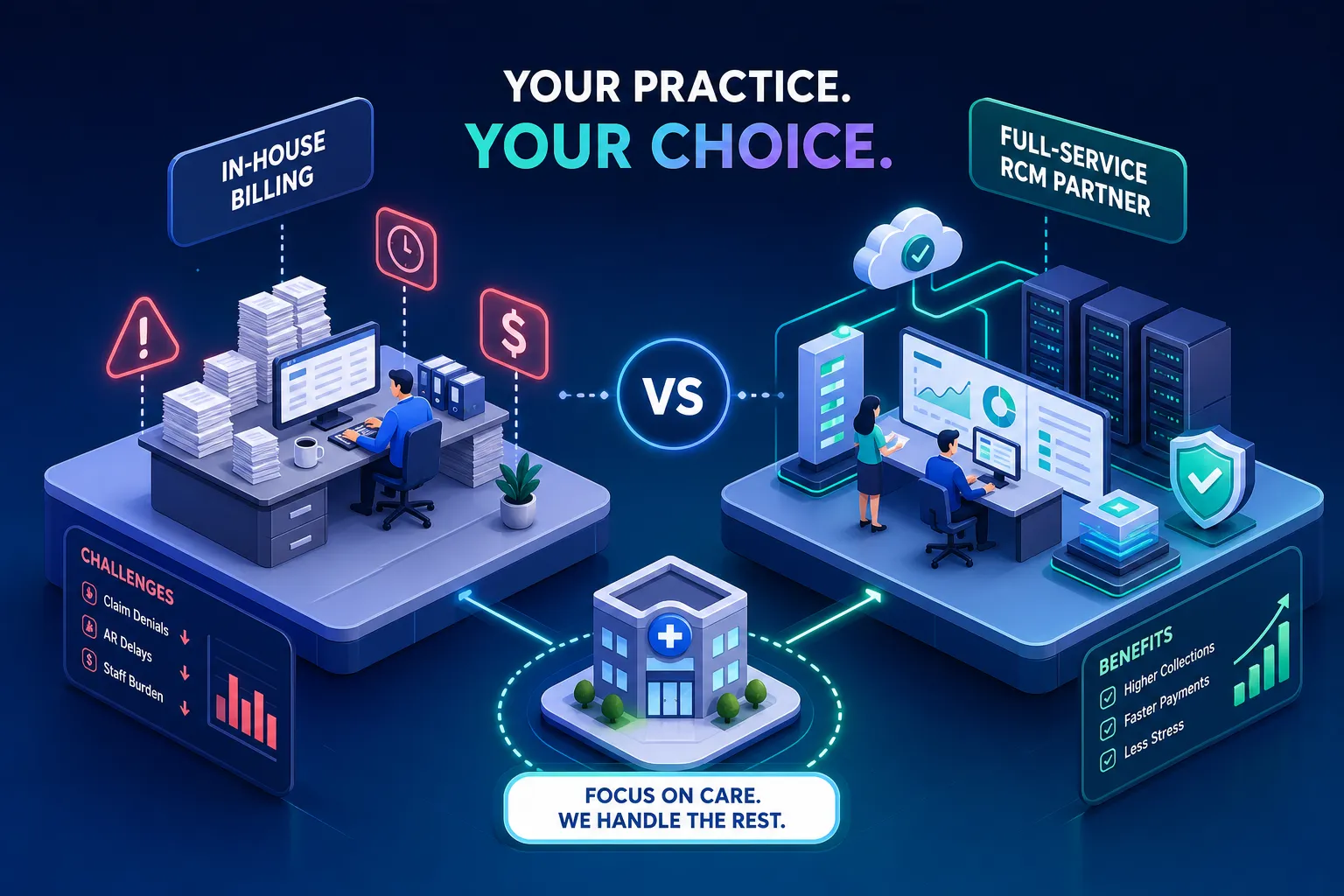
Many independent outpatient practices assume their medical billing is running smoothly, until a denial audit arrives, or a cash-flow gap forces a closer look at the numbers. What emerges is rarely reassuring: aged accounts receivable that nobody has chased in months, eligibility errors from the front desk carried forward into every claim, and a denial rate sitting quietly above 10%. These are not isolated problems. They are the predictable result of treating the billing function as an afterthought rather than as the financial engine of the practice.
Revenue cycle management, the full financial workflow that runs from patient registration through to final payment collection, is not a single task. It is an interconnected chain of nine to ten stages, and a failure at any one of them creates leakage downstream. The question this article addresses is a practical one: does it make more financial sense to manage that chain internally, or to hand it to a specialist partner? At CredSpun, working with practices at launch and mid-transition has made one thing clear. The answer rarely comes down to preference. It comes down to capacity, expertise, and what revenue leakage is actually costing the practice each month.
What medical billing and coding really means for an outpatient practice
Medical billing is not just the act of sending a claim. It begins at registration, when a patient's insurance coverage is verified and prior authorization is obtained for any procedure that requires it. From there, the provider documents the encounter, every billable service is captured, and a medical coder translates that documentation into standardized codes: ICD-10-CM for diagnoses, CPT for procedures, and HCPCS for supplies and equipment. Those codes form the basis of the claim.
The claim is then scrubbed for errors, submitted electronically through a clearinghouse, and adjudicated by the payer. If payment is approved, it is posted against the account via an Electronic Remittance Advice (ERA). Whatever the payer does not cover becomes a patient balance, which triggers the final stage: patient billing, statement cycles, and AR follow-up. Each stage depends on the one before it. A registration error creates a denial at adjudication. A coding error creates an underpayment at payment posting. Weak patient billing means that final balance never gets collected.
Medical coding and medical billing are related but distinct. Coding asks: what care did the patient receive? Billing asks: how do we get paid for it? Coders and billers need each other, but they are not interchangeable roles. Assigning both functions to one undertrained person increases the risk of upcoding exposure, systemic claim errors, and denial rates climbing well above acceptable thresholds. Separating the roles, or working with a partner who manages both under a single accountable workflow, is not a luxury. It is a structural necessity.
Where revenue silently leaks out of the medical billing cycle
Front-end failures: eligibility and prior authorization
The front end of the billing process, specifically eligibility verification and prior authorization, accounts for a disproportionate share of claim denials. Industry analyses, including figures cited by major clearinghouse and payer audit reports, attribute 18 to 29% of denials to registration errors alone. In practice, this looks like a patient checked in without confirmed active coverage, a prior authorization that was never obtained before a procedure, or payer information pulled forward from a previous visit without re-verification. These errors are largely preventable with proper controls, yet they remain common in practices that rely on rushed front-desk workflows.
Claim submission errors
At the claim submission stage, the most frequent problems are invalid CPT and ICD-10 code combinations, missing or incorrect modifiers, demographic mismatches, and timely-filing violations. Many in-house teams treat clearinghouse rejections and payer denials as the same problem, a costly mistake. A clearinghouse rejection means the claim never reached the payer and must be corrected and resubmitted immediately. A payer denial means the claim was reviewed and refused, requiring investigation, correction, and often a formal appeal. Conflating the two delays reimbursement and risks write-offs on claims that should have been recoverable.
Aged AR and patient collections
Aged AR is where uncollected revenue becomes permanent loss. Many in-house billing teams prioritize new claims over chasing balances that are 60, 90, or 120 days old. By the time someone looks at those accounts, timely-filing limits may have passed or the patient is simply unreachable. A weak patient billing process that sends statements late, offers no payment plan options, and has no designated person responding to inbound billing calls consistently suppresses the net collection rate. For most outpatient practices, this is where the biggest, quietest losses occur.
The real cost of managing medical billing in-house
Running a competent in-house billing operation requires, at minimum, one experienced biller with working knowledge of payer-specific rules, denial management, and AR follow-up protocols. Ideally, that person is separate from the coder. For practices operating in the United States, the primary market these benchmarks reflect, the all-in annual cost for a single biller typically runs between $72,000 and $92,000 when recruiting costs, onboarding time, salary, employer payroll taxes, benefits, practice management software, clearinghouse fees, and ongoing training are factored in. Most small practices underestimate this figure significantly when making the hire-versus-outsource comparison.
The technology side is equally demanding. Setting up EDI 837P claim transmission and ERA 835 payment posting is not plug-and-play. Clearinghouse enrollment, EFT setup per payer, and payer-specific EDI agreements each require careful follow-through. Practices launching without proper clearinghouse configuration routinely face delayed first submissions and reconciliation errors that persist for months. The setup checklist alone, from clearinghouse account creation through to end-to-end claim testing, has more than a dozen sequential steps that must be completed correctly before a single production claim can transmit reliably.
The single-point-of-failure risk is perhaps the most underappreciated operational hazard. When one person owns the entire billing workflow and that person resigns, falls ill, or takes even a brief leave, claim submissions stop. AR goes unworked. Payer portal credentials tied to a personal login become inaccessible. The practice manager is left scrambling to cover a function that nobody else fully understands. Many practices find themselves in exactly this situation mid-transition, carrying months of unworked AR and a cash-flow gap that proper workflow design could have prevented entirely.
What a full-service RCM partner actually delivers
There is a meaningful difference between a billing-only arrangement and genuine end-to-end revenue cycle management. Billing-only typically means the partner submits claims and follows up on rejections, while the practice still manages provider credentialing, payer enrollment, prior authorizations, clearinghouse setup, and patient billing separately. Each of those handoffs is a potential failure point. A true end-to-end partner eliminates those handoffs by owning the entire medical billing and collections cycle, from the moment a new provider needs to be enrolled through to the final patient payment.
Case example
Consider a newly launched outpatient practice that engaged CredSpun during its build-out phase, before seeing its first patient. CredSpun managed CAQH, PECOS, Medicare, and commercial payer enrollments through to confirmed effective dates, configured the clearinghouse and ERA routing in parallel, and submitted the practice's first clean claims on day one of operations. The result, based on the practice's own reporting, was a denial rate below 5% within 60 days and a cash-flow timeline well ahead of what practices typically experience when credentialing and billing are managed as two separate, sequential processes. The difference was integration: credentialing, EDI setup, and billing workflow were treated as one project, not three.
The reporting a reputable RCM partner delivers each month is another critical distinction. Clean claim rate, first-pass acceptance rate, days in AR, denial rate broken down by payer and reason code, and net collection rate by provider: these are the numbers that tell a practice owner whether the revenue cycle is healthy or quietly deteriorating. Equally important is having a named, dedicated billing contact who owns those numbers and can explain them. A shared service queue, where accountability is diffused across a team and nobody is specifically responsible for your practice's AR, is not a substitute for that.
Practical signals to guide your medical billing decision
In-house billing is a realistic option when the practice has a consistent, experienced biller with documented RCM knowledge and a defined workflow for denials and AR follow-up. It works when the technology infrastructure is already in place, when claim volume is low enough that the biller is never overwhelmed by competing priorities, and when the practice owner has the management bandwidth to actively supervise billing performance. For some practices, particularly those with a single provider, a straightforward payer mix, and an exceptional biller, keeping medical billing in-house can be a sound choice.
The clearest signals that it is time to bring in an RCM partner are measurable. A denial rate consistently above 10%, days in AR climbing past 45 to 50, or a net collection rate below 95% each signal that revenue is escaping the cycle before it is collected. A biller departure creating coverage gaps is an operational emergency. A specialty practice, such as a mental health clinic or a procedure-heavy outpatient center, facing complex payer rules the current team cannot navigate represents a structural mismatch. In many of these situations, a full-service partner can produce a positive return when compared with the revenue lost to unworked denials and aging AR; practices should run their own ROI comparison using denial rate, days in AR, and current staffing costs.
Before making the decision, ask any potential partner these questions directly:
- 01Do you assign a named, dedicated billing contact or operate through a shared queue?
- 02How do you manage the transition period when taking over from an existing billing operation?
- 03What is your standard denial rate, and how do you measure it?
- 04How quickly after the service date do you submit clean claims?
- 05Do you manage credentialing and payer enrollment, or is that handled separately?
The answers reveal more about how a partner actually operates than any service brochure will, and the gaps in those answers are just as telling as the answers themselves.
The decision is not about preference; it is about numbers
There is no universally correct model for managing the medical billing and revenue cycle of an outpatient practice. There is, however, a right answer for each practice's specific situation, and that answer is found in the data. Denial rates, days in AR, net collection rates, and the true cost of staffing are not abstract metrics. They are the numbers that determine whether a practice is financially healthy or slowly losing revenue through gaps it has not yet noticed.
For practices launching without credentialing in place, transitioning away from an underperforming billing team, or watching AR age without resolution, a full-service RCM partner removes the operational risk and replaces it with a structured, accountable workflow. CredSpun works with independent outpatient practices to manage the full cycle, from credentialing through patient collections, on a month-to-month basis, with a dedicated billing contact and transparent monthly reporting. If your denial rate, days in AR, or net collection rate are not where they should be, a billing audit is the concrete first step. CredSpun offers an initial review at no cost.
No-cost billing audit
Find out what revenue leakage is costing your practice.