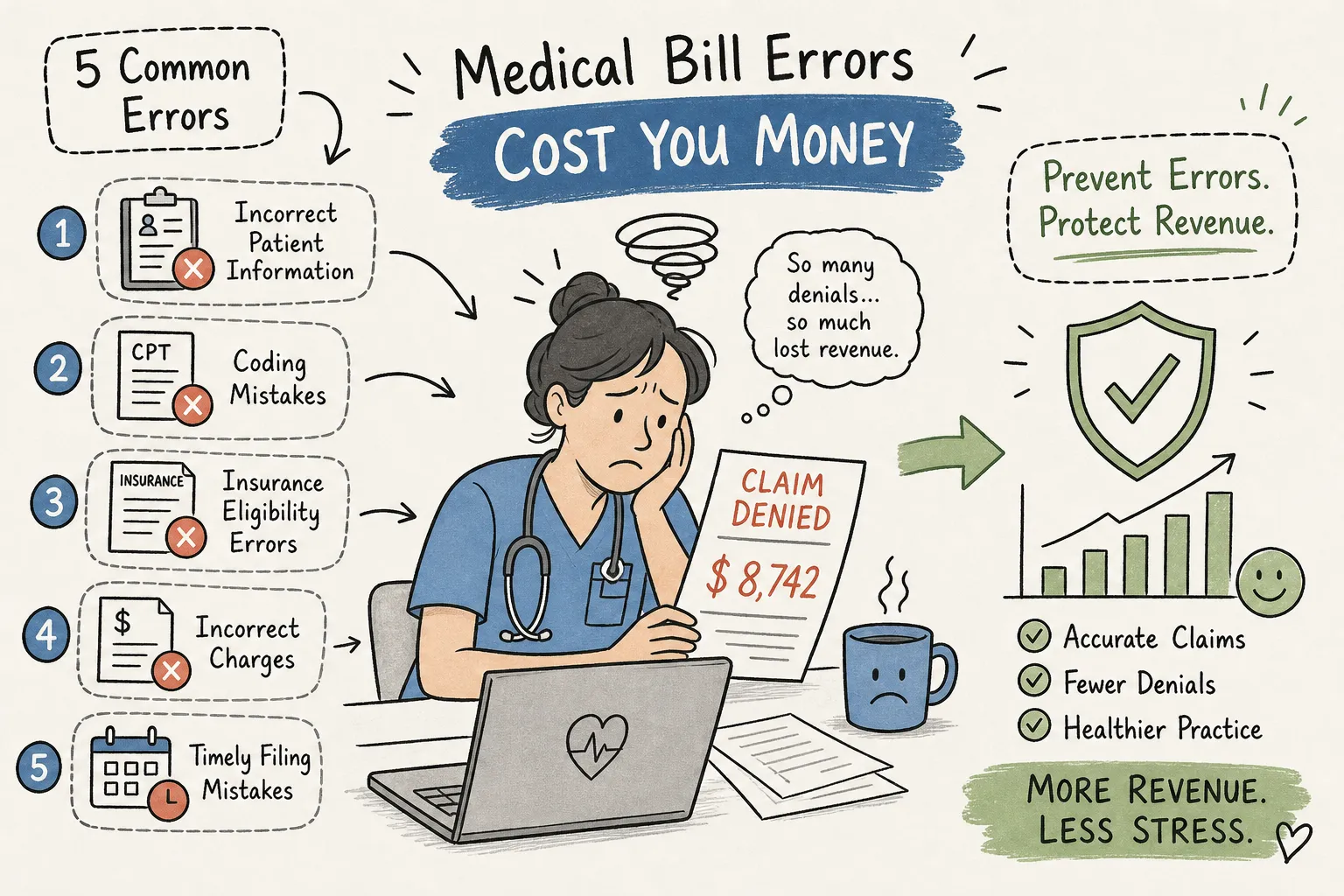
Industry-reported estimates suggest that up to 80% of medical bills contain at least one error, a figure cited by billing advocacy groups, though outpatient-specific research typically puts the rate lower, at around 15% to 25%. Even at the lower end, the financial impact is real. Many errors go unnoticed until cash flow has already taken the hit. For outpatient practices, the damage accumulates: a missed code here, an unverified eligibility status there, and by the end of the quarter, you are staring at an accounts receivable report that makes no sense relative to the volume of patients you saw.
This article is written by the billing team at CredSpun, and these are the exact errors we work through every day on behalf of outpatient practices. Whether you are a practice manager trying to tighten your revenue cycle, or a patient who suspects their clinic invoice does not add up, this piece gives you a working understanding of what a medical bill actually contains, how to read the documents that validate it, the five errors most likely draining your revenue, and what to do when something is wrong.
What an outpatient medical bill actually contains
Most people treat a medical invoice as a single number at the bottom of a page. It is not. A compliant medical billing form is a layered document, and each layer is independently verifiable and independently disputable. Understanding those layers is the foundation of catching errors before they cost you money.
The line items behind every medical bill charge
A properly structured healthcare invoice must include several core fields: the provider's legal name, clinic address, license number, and NPI. It should also carry a unique invoice number, the issue date, payment due date, and any applicable tax IDs or payment instructions; check your payer's requirements, as these vary. On the patient side, it needs the full name, date of birth, account number, and the guarantor's details if different from the patient. Every service then appears as its own line entry, showing the date of service, a description, the relevant procedure code (CPT or HCPCS), the diagnosis code (ICD-10), quantity, unit price, and line total.
Pharmacy items, laboratory investigations, and procedural services each carry separate line entries. To illustrate: a single two-day outpatient visit can generate a dozen or more individual charges, depending on the procedures performed. Every line is independently billable, which means every line is independently disputable. If you cannot see the itemized breakdown on your hospital bill or outpatient statement, request it before paying anything.
How gross charges become the patient balance
The gross charge is the top-line figure before any adjustments. It is rarely what anyone actually owes, and confusing it with the final balance is one of the most common sources of unnecessary overpayment. The arithmetic from gross charge to patient responsibility moves through a predictable sequence.
| Billing stage | Example amount |
|---|---|
| Gross charges | $2,930 |
| Contractual / insurance adjustment | −$1,030 |
| Insurance payment | −$1,500 |
| Deposit already paid | −$100 |
| Estimated patient balance | $300 |
These figures are illustrative, but the structure is standard. The gross charge gets reduced first by the negotiated rate your insurer has agreed to pay, then by the insurer's actual payment, then by anything you have already contributed. What remains is your responsibility. Any patient statement that skips those middle steps and asks you to pay the gross amount is worth questioning immediately.
How to read an Explanation of Benefits
The Explanation of Benefits is the document that most billing disputes hinge on, yet it is the one most often set aside unread. The EOB is not a bill. It is your insurer's processing record, and it tells you exactly what the plan agreed to cover, what it paid, and what it expects you to contribute. Used correctly, it is the most reliable cross-checking tool you have.
The four columns that matter most on an EOB
If the patient balance on your clinic invoice is higher than the member responsibility shown on your EOB, that gap is where medical bill errors hide.
Spotting EOB-to-invoice mismatches before paying
Place the itemized invoice and the EOB side by side and work through each service line. Look for dates that appear on the invoice but not on the EOB, which may indicate services that were never submitted to the insurer. Look for insurer payments on the EOB that are not reflected as credits on the patient-facing bill. Where a line has been denied and the practice has billed it directly to the patient, there should be a clear notation explaining why; if there is none, the practice should be resubmitting or appealing rather than treating the denial as a settled matter.
Each denied line on an EOB carries a denial reason code. These are typically CARC codes, for example, CO-16 (missing claim information), CO-15 (missing prior authorization), or CO-97 (bundled service), and they tell you the exact reason a claim failed. Reviewing the CARC/RARC guidance published by the relevant claims administrator will help you verify the meaning of any code you encounter. If a denied line appears on your patient statement without explanation, that is a prompt to contact the billing office, not to pay.
Five medical bill errors draining outpatient revenue
These are not edge cases. They are the errors that appear repeatedly across outpatient practices regardless of specialty, size, or whether billing is handled in-house or outsourced. Each one has a root cause that is fixable.
Duplicate charges and unbundled codes
Duplicate billing occurs when the same service appears more than once on a claim, often because different departments or systems logged it independently. Unbundling is the reverse problem: a single procedure that carries one CPT code gets split into its component parts and billed separately, inflating the total. Both errors trigger automatic rejections from most payers and are among the top flags in billing audits. Neither requires intent to cause significant revenue disruption; they happen routinely in busy practices without a claim scrubber catching them pre-submission.
Incorrect patient or insurance information
A transposed date of birth, a misspelled surname, an outdated policy number, or an incorrect network affiliation can send an otherwise clean claim back without payment. Industry denial data places registration and eligibility errors at 18 to 29% of total denials across commercial payers. The corrective action sounds simple, but it only works if eligibility is verified at the point of scheduling, not at the point of billing. By the time a claim reaches the clearinghouse with wrong information, the appointment has already happened and the service has already been delivered.
Missing prior authorization or eligibility gaps
Prior authorization failures account for roughly 10 to 15% of claim denials. When a covered procedure is delivered without obtaining authorization first, the payer often refuses to grant retroactive approval, and the denial stands regardless of how well-documented the clinical necessity is. Eligibility gaps carry a similar risk: if a patient's coverage has lapsed or a provider is out-of-network at the time of service, the practice absorbs those charges as write-offs.
Prior authorization denials are not always unrecoverable, but acting on them requires a deliberate effort. Among practices that do appeal, overturn rates range from 43% to 82% depending on the payer. Yet only around 11% of denials are ever appealed at all, which means the majority of potentially recoverable revenue is written off without challenge.
Upcoding and under-documentation
Upcoding means billing a higher-complexity service than was actually delivered. The most commonly flagged outpatient codes in billing audits are 99214 and 99215, where the documentation supports a lower-level visit than the one billed. Under-documentation is the other side of the same problem: the service was delivered and was legitimately complex, but the clinical notes do not support the code on audit review, resulting in a downgrade or denial.
Misapplied adjustments and stalled claims
Misapplied adjustments compound these issues further. Crediting the wrong payer rate, failing to post an insurer payment, or leaving a claim in “pending” status indefinitely: each of these builds into significant AR backlogs that become expensive to untangle over time.
How to dispute a medical bill error the right way
Whether you are a patient reviewing a clinic invoice or a practice manager dealing with a payer denial, the dispute process follows a logical sequence. Skipping steps wastes time and weakens your position.
Validate the charge before challenging it
Request a fully itemized bill if you do not already have one. Pull the corresponding EOB. Compare both against the clinical record, whether that is an appointment confirmation, discharge summary, or procedure notes. You need to identify the specific line item, the date of service, the code in question, and the precise reason it is wrong before you contact anyone. Disputes that arrive without this preparation are easily dismissed.
Filing a formal dispute with a provider or insurer
Contact the provider's billing office in writing and request an internal billing review. Your written request should include the account number, date of service, the exact line item in dispute, and the specific correction you are requesting, whether that is a duplicate removal, a code correction, or a resubmission to the insurer. If the error is on the insurer's side, file a formal appeal through the plan's member services using the claim number from the EOB. Keep a written record of every call, every letter, every reference number, and every response. If the dispute remains unresolved, escalate to your state's insurance regulator. Most internal billing reviews take 30 to 60 days; most insurance appeals under regulated plans must be filed within 180 days of the denial.
Preventing these errors before they reach the payer
Catching a medical bill error after submission is far more costly than preventing it upstream. The practices that maintain low denial rates and strong net collection rates are not simply lucky; they have built verification and review steps into every stage of the revenue cycle before a claim ever leaves the building.
A clinic checklist to reduce revenue leakage
- 01Verify patient eligibility and active coverage at every visit, not just at registration
- 02Confirm prior authorization before delivering any procedure that requires it
- 03Run all claims through a scrubber to catch coding errors before submission
- 04Reconcile EOBs against patient balances weekly, not at month end
- 05Track denial reason codes by category and address root causes rather than individual claims
- 06Ensure provider credentialing and payer enrollment are current before billing begins for any new provider or location
How end-to-end RCM removes these errors at the source
The checklist above works well when someone owns every item on it consistently. For many outpatient practices, that is the actual problem: the steps are known, but the bandwidth to execute them daily does not exist in-house. This is the structural gap that a full revenue cycle management service addresses.
From our work
CredSpun has worked with outpatient practices where eligibility was being verified inconsistently and denials were accumulating without root-cause review. Once full RCM was in place, covering eligibility verification before every visit, claim scrubbing before transmission, and daily denial management with monthly pattern analysis, denial rates dropped substantially within a few billing cycles. When the same denial pattern appeared three times in a row, the upstream process was corrected rather than just the individual claim.
CredSpun covers every stage from payer enrollment and prior authorization through denial management and AR follow-up, which is precisely where most medical bill errors slip through when practices manage the revenue cycle in fragments.
Protecting your revenue starts with the process
A medical bill is not just a number at the bottom of a page. It is the output of every clinical, administrative, and coding decision made during a patient encounter. Errors accumulate when any step in that chain is skipped, rushed, or handed off without a clear owner.
Practice managers who build eligibility verification, coding review, and denial tracking into their daily workflow protect revenue before it is lost, rather than trying to recover it after the fact. Patients who learn to cross-check their itemized statement against the EOB, treating it as they would any other financial document, catch errors before paying for services they do not actually owe. Both outcomes are achievable with the right process in place.
If your practice is managing medical bill processing in-house and the denial rate, days in AR, or net collection rate is not where it should be, get in touch with the CredSpun team. We work with outpatient practices to build and maintain the systems that make these errors the exception rather than the standard.
No-cost billing audit
Find out which errors are costing your practice.