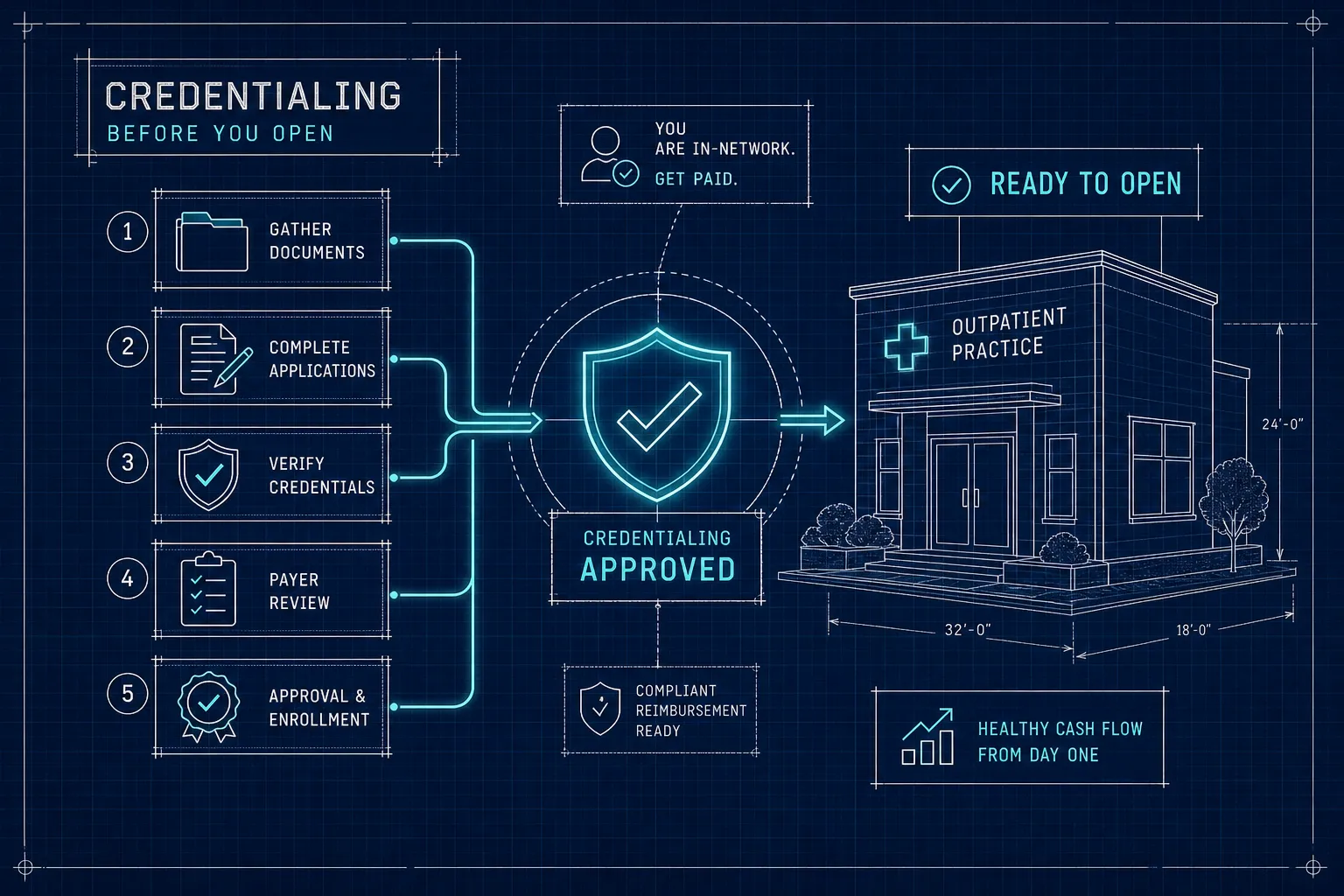
Medical billing credentialing is the one administrative task new outpatient clinics most commonly overlook. Most practices spend the better part of a year planning the clinical side of their launch: equipment ordered, staff hired, EHR configured, lease signed. Then, two weeks before opening, someone asks: “Are we credentialed with the insurance payers yet?” It is a question that comes too late far more often than it should, and that single gap is what turns a well-prepared clinic into one that cannot collect a dollar on day one.
Provider credentialing is the verification process by which insurance payers confirm that a clinician is qualified to deliver care. It is not billing. It is the gate that billing must pass through. Once a payer completes its review and assigns an effective date, claims can be submitted for services rendered from that date forward. For most payers, any claim submitted before that effective date rejects outright. Medicare does allow limited retroactive billing in specific circumstances, typically up to 30 days before the filing date and up to 90 days following a declared disaster, but these exceptions are neither guaranteed nor reliable enough to plan around.
CredSpun's credentialing team frequently sees the same pattern in new-practice engagements: a solo physician submits their first commercial payer application two months before opening, then spends the first four months of practice absorbing costs they cannot recover. This article covers the four enrollment tracks, the documents required, realistic timelines, common delays, and what it genuinely costs to manage credentialing in-house versus outsourcing it.
Credentialing and billing are two entirely different processes
What provider credentialing actually does
Credentialing is a verification exercise. The payer checks the clinician's licenses, educational background, training history, malpractice record, and board certifications. After that review clears, the payer assigns a provider ID, links the clinician to a contracted group, and sets an effective billing date. None of that is billing. Billing is what happens after you pass through the gate. Treating them as the same process is the single most expensive mistake a new practice can make.
Where billing begins and where gaps form
The handoff is straightforward on paper: once a confirmed effective date exists, claims can go out. The gap that hurts new practices is the stretch of time between opening day and that confirmed effective date. Claims submitted before the effective date do not pend for review; they reject. Some payers will grant a retroactive effective date under specific circumstances, but that outcome is not reliable enough to plan around. Credentialing must be built into pre-launch operations, not treated as an administrative formality to sort out after the doors open.
The four enrollment tracks every outpatient practice must complete
CAQH ProView: the foundation for commercial payers
CAQH ProView is not insurance enrollment. It is a centralized data source that most commercial payers draw from when conducting their credentialing reviews. The provider creates a profile, enters demographic, training, license, and malpractice information, uploads supporting documents, and grants each payer access to that data. Per CAQH guidance, attestation must be renewed at least every 120 days. A profile that is incomplete, unattested, or has payer access withheld stops commercial credentialing reviews before they begin. Completing CAQH is the prerequisite for almost every commercial application, so it should be the first task on the enrollment calendar.
PECOS: enrolling with Medicare
PECOS is the Medicare enrollment portal. The provider selects the correct CMS-855 form type: individual (855I), organization (855B), or benefit reassignment (855R). Information entered must match NPPES, the W-9, and state license records exactly, character for character. Medicare does not use CAQH; it runs its own primary-source verification. CMS standards call for clean PECOS applications to be processed within 15 to 50 days, but MAC backlogs, missing documentation, and development requests routinely push real-world timelines to 60 to 90 days. Plan for 90 to 120 days as your operating assumption.
State Medicaid and managed-care plans
Medicaid requires a separate application for the individual provider, the group, and often each managed-care plan operating in the state. In states like Texas, California, and Florida, a confirmed state Medicaid enrollment number does not automatically make the provider in-network with every MCO; those are separate contracting processes.
Commercial payer applications
Commercial payers use a combination of CAQH data, their own portals, and clearinghouses like Availity. The submission channel varies by payer, and submitting through the wrong channel wastes weeks. When managing four to eight concurrent commercial payer applications alongside Medicare and Medicaid, the administrative coordination alone can become a full-time responsibility for practices without dedicated staff.
Medical billing credentialing: documents to have ready before you submit anything
Provider-level documents
The core provider documents include a government-issued photo ID, individual NPI (Type 1), active state professional licenses, DEA registration if applicable, board certification, medical school diploma, full training history with no unexplained gaps, a current CV, and a malpractice certificate showing carrier, policy number, limits, and coverage dates. Every document must be current at the time of submission and must remain current throughout the review. Expired documents are among the most common reasons applications are returned without review, and resubmitting can significantly delay processing, in many cases placing the file behind newer submissions already in the payer's queue.
Practice-level documents and the consistency rule
Practice-level records include the group NPI (Type 2), IRS Form W-9 matching the enrolled entity, business license, ownership disclosures, EFT details and a voided check for ERA setup, and practice location and billing address information. The consistency rule is non-negotiable: the legal name, NPI, TIN, taxonomy code, and address must match character for character across NPPES, PECOS, CAQH, payer applications, and the W-9. A single mismatch between these systems is enough to generate a rejection. This is the category of error that practices can actually control and prevent, yet it is among the most common reasons applications come back.
How long this takes and when to start
A realistic timeline by payer type
Medicare through PECOS typically takes 60 to 90 days for a clean application, though MAC backlogs and discrepancies push this to 120 days or more in practice. Medicaid ranges from 90 to 180 days depending on the state, with some states requiring site visits, fingerprinting, and separate managed-care plan enrollment on top of the state application. Large commercial payers, including UnitedHealthcare, Anthem, Cigna, and Aetna, generally run 90 to 150 days. Approval from the credentialing committee is not the finish line. Roster loading and billing-system activation add another 30 to 45 days after the committee signs off before claims can actually transmit and pay.
| Track | What stretches it | Typical timeline |
|---|---|---|
| Medicare (PECOS) | 120+ days with MAC backlogs or discrepancies | 60–90 days |
| State Medicaid | Site visits, fingerprinting and separate managed-care plan enrollment in some states | 90–180 days |
| Large commercial payers | UnitedHealthcare, Anthem, Cigna, Aetna and similar | 90–150 days |
| Roster loading after approval | Before claims can actually transmit and pay | 30–45 days |
Building your pre-launch enrollment calendar
The practical rule is simple: submit all applications at least four to six months before your intended opening date. Identify your priority payers first, Medicare and your two or three highest-volume commercial plans, then work backward from your target opening date to set submission deadlines for each. CredSpun's credentialing team uses a pre-launch calendar as standard practice, submitting concurrent applications with staggered follow-up schedules so that no single application sits idle waiting for another to resolve. That structure is what prevents the billing gaps that most credentialing-related cash-flow problems come from. Credentialing is only one part of launch readiness; our guide to setting up medical billing for a new practice covers the EDI, ERA and EFT setup that has to run alongside it.
What delayed or incomplete credentialing does to your cash flow
How enrollment gaps create claim rejections
When a provider sees patients and submits claims before the effective date is confirmed, every claim rejects. The practice has already incurred the cost of care but collects nothing for it. If a retroactive effective date is not granted, and Medicare limits that to 30 days before the filing date under specific conditions, that revenue is permanently gone. Beyond opening day, ongoing credentialing problems compound the damage: a lapsed CAQH attestation, an expired license on file, or a missing benefit reassignment generates individual payer rejections that stack quietly in accounts receivable without obvious explanation until someone audits the denial pattern.
The AR spiral that follows
Rejected claims age in AR. Denial rates climb. Staff time that should go toward clean-claim submission gets consumed by rework and appeals. Days in AR extend well beyond the 30-day benchmark that healthy practices maintain, and for a new practice, that cash-flow gap can become a genuine operational threat within the first quarter. Credentialing is not a compliance formality. It is revenue protection. Every week of delay on the enrollment side is a week of billable revenue the practice cannot recover, and a growing backlog for AR follow-up to work through later.
Managing this yourself versus hiring a credentialing service
What in-house credentialing actually costs
Based on industry planning estimates, a solo provider managing credentialing internally typically spends between $2,000 and $5,000 in staff time and administrative costs in the first year. For a small group of three to five providers, that figure rises to $6,000 to $15,000, and it requires a coordinator who genuinely understands CAQH maintenance, payer portals, expiration tracking, and follow-up protocols across multiple concurrent applications. A fully loaded in-house coordinator, accounting for salary, benefits, payroll taxes, software, and management time, runs closer to $75,000 to $100,000 annually. The hidden cost is not the coordinator's salary; it is the revenue lost during delays caused by inexperience with payer-specific requirements and submission channels.
What to look for in a credentialing partner
For most outpatient practices, unless the volume of ongoing credentialing is enough to keep a dedicated specialist consistently occupied, outsourcing is more economical and faster. When evaluating a credentialing service, the questions that matter most are:
- 01What is the median time from complete information to a confirmed effective date, broken down by payer?
- 02What percentage of applications clear on the first submission without a correction request?
- 03Who owns the CAQH profile and application data if the relationship ends?
How CredSpun approaches credentialing
CredSpun manages the full enrollment process: CAQH setup, attestation, and maintenance; PECOS and Medicare enrollment; state Medicaid and managed-care plan applications; and commercial payer submissions through to a confirmed effective date, with written confirmation of the provider ID, enrolled locations, and billing start date. Each practice works with a named billing contact rather than a shared service queue, which means follow-up with payers happens on a defined schedule rather than whenever someone gets to it. For new practice launches and transitions from an underperforming billing arrangement, CredSpun submits applications concurrently and assigns an active owner and escalation deadline to each.
Outsourced credentialing for a solo provider with five to eight payer contracts typically costs $2,000 to $7,500 in the first year and $1,500 to $4,000 annually thereafter. Against the $75,000 to $100,000 fully loaded cost of an in-house coordinator, the economics are straightforward for any practice that does not have continuous, high-volume credentialing activity.
Start early, stay consistent, know who owns it
Medical billing credentialing is not the last item on the pre-launch checklist. It is the first. Everything in the revenue cycle, from claim submission to payment posting and AR follow-up, depends on enrollment being complete and effective before the first patient walks in. The process is manageable when it starts early, uses accurate and consistent documentation across every system, and has a clear owner tracking each application to a written, confirmed effective date.
For most outpatient practices, the decision to outsource is about more than saving time. It is about not losing revenue during the most financially vulnerable period of the practice's life. Whether a clinician manages this in-house or works with a partner like CredSpun, the non-negotiable is the same: start six months out, submit applications concurrently, and follow up on every single one until a confirmed effective date is in writing. Anything less is a gamble with the practice's first year of cash flow.
If you are planning a practice launch or switching from an underperforming credentialing arrangement, contact the CredSpun team directly. The enrollment calendar starts the day you decide to open, not the day you sign the lease.
Opening a practice?
Get every payer enrolled before your first patient.