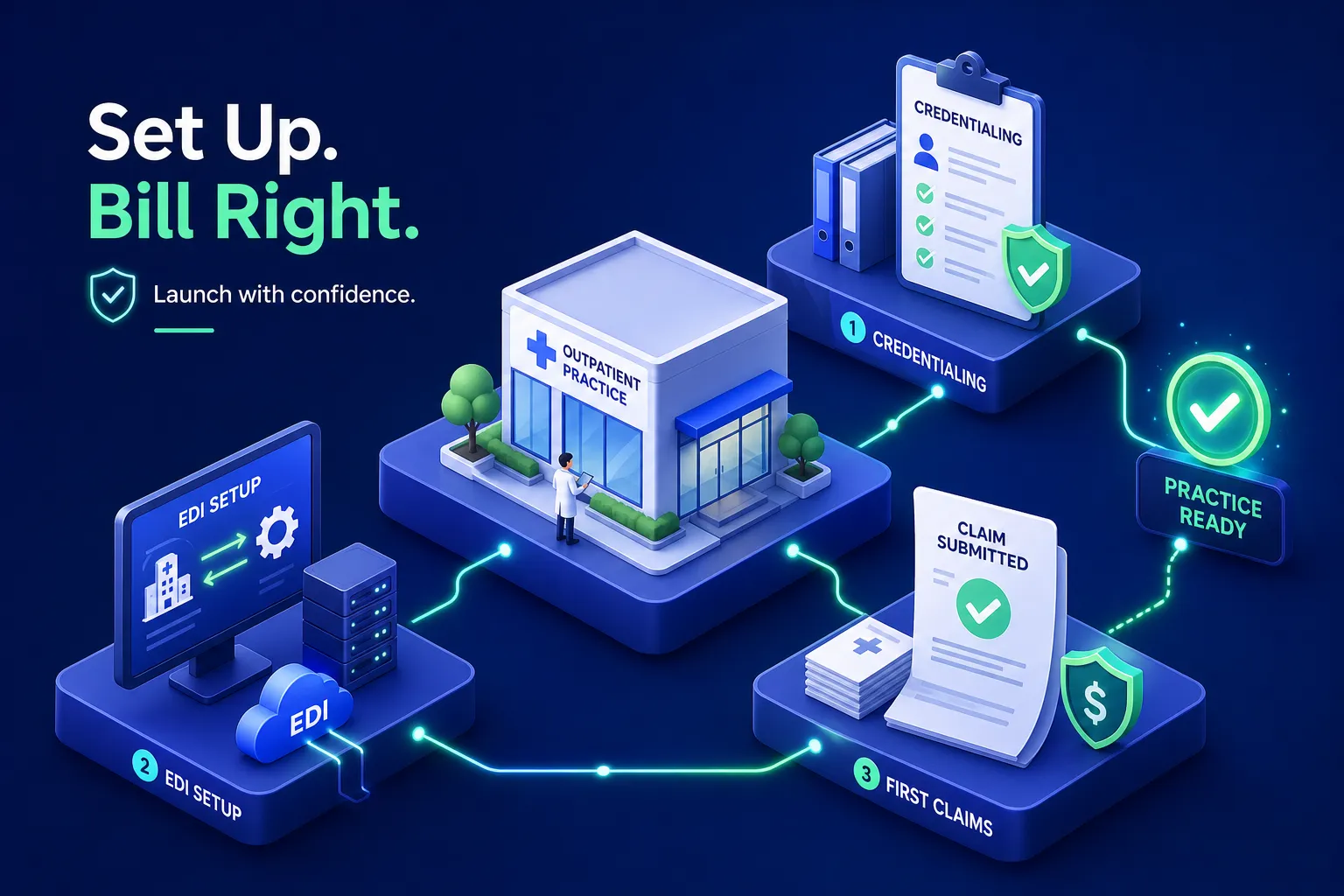
Getting medical billing right for a new outpatient practice starts months before opening day. Most new outpatient practices spend their first three months perfecting the clinical setup, hiring staff, and ordering equipment, and the medical billing process gets pushed to the final week before opening. That single decision routinely delays the first payment by three to six months, and in many cases it means the revenue from those early patient encounters is difficult or impossible to recover. Before a single claim goes out, three things must be in place: credentialing, EDI setup, and a clean claim workflow. Get those right, and cash flow starts on schedule. Skip any one of them, and you are recovering ground for the next year.
At CredSpun, we onboard new outpatient practices every month, and the ones that struggle most are the ones that thought billing could wait. This article is a practical walkthrough from people who have done this repeatedly, not a theoretical overview. By the end, you will know the exact sequence to follow, where most practices hemorrhage revenue, and how to fix it before the losses compound.
Medical billing credentialing and payer enrollment: the infrastructure that must exist before billing starts
Credentialing is not an administrative formality. It is the legal and contractual permission to bill a payer. Without a confirmed effective date from each insurer, many claims you submit will be denied as a non-contracted provider, and the volume of those denials can effectively shut down your revenue stream in the opening months. The typical credentialing timeline runs 90 to 180 days for most commercial payers, which means the process must begin months before the practice opens its doors. Many new practices discover this too late; revenue from those early patient encounters can be extremely difficult to recover retroactively, and in some cases appeals or retroactive enrollment may not be available.
The process itself involves completing your CAQH profile, enrolling in PECOS for Medicare, applying to your state Medicaid program, and submitting individual applications to each major commercial payer you intend to bill. Each payer has its own application form, its own attestation requirements, and its own follow-up cadence. Incomplete applications or missing documents are among the most common and significant causes of credentialing delays, alongside committee review cycles and payer contracting timelines. Regular follow-up (for example, weekly) and active case management materially reduce the time applications spend sitting in internal review queues.
One point that catches new practices off guard: credentialing approval and a signed contract are two separate things. After approval, you still need the payer to issue a contract, execute it, load your information into their system, and confirm an effective date in writing. Using the wrong effective date on claims is a common and costly error. Practices that outsource this work to a specialist avoid the most expensive delays and start billing on schedule. CredSpun manages CAQH, PECOS, Medicare, Medicaid, and commercial enrollments through to a confirmed effective date, removing the administrative burden from clinical staff who should be focused on patient care.
Medical billing setup: EDI, ERA and EFT so claims transmit from day one
Electronic claims do not travel directly from your practice management system to an insurer. They pass through a clearinghouse, which translates the claim into the payer's required EDI format, runs a first-pass scrub for errors, and routes it to the correct payer. Without clearinghouse setup, claims either cannot be submitted electronically or will reject before adjudication even begins. To put it plainly:
EDI enrollment is required for electronic claims submission; ERA and EFT enrollments are strongly recommended before your first payment to avoid the delays and errors that come with manual posting.
The setup sequence runs as follows: select a clearinghouse, obtain payer-specific trading partner agreements, enroll for ERA and EFT with each payer individually, and test the connection with a sample claim batch. ERA and EFT enrollment are separate from EDI enrollment and are frequently skipped by new practices. The result is paper checks arriving weeks late and manual remittance posting, which slows cash flow and creates payment-posting errors that inflate your apparent accounts receivable.
Common clearinghouse errors to catch early
The most common clearinghouse rejection errors are mismatched payer IDs, incorrect NPI or taxonomy codes, and subscriber demographic mismatches, all of which are preventable with a proper setup checklist. This is a one-time configuration that pays dividends for years once it is done correctly.
The full medical billing and coding cycle from patient registration to paid claim
The front end of the revenue cycle determines whether a claim will pay before the patient ever sees the provider. The sequence is straightforward: registration, eligibility verification for the specific date of service, prior authorization where required, and copayment collection at check-in. Each stage is a revenue checkpoint. A single eligibility miss can trigger a denial that takes weeks to correct and ties up staff time that should be spent on productive work. Verifying eligibility on the registration date rather than the date of service is one of the most common and avoidable errors in outpatient billing.
After the visit, the provider's documentation is translated into ICD-10 diagnosis codes and CPT procedure codes, charges are entered into the billing system, and a claim is assembled. Before submission, the claim passes through a scrubbing step: an automated check that catches missing data, invalid code combinations, and eligibility problems. Many high-performing operations target a clean claim rate above 90 to 95% with robust scrubbing, but this requires both accurate coding and a well-configured billing system. Practices that skip claim scrubbing or rely on a poorly configured system push those errors downstream, where they become denials and appeals.
Once the claim is transmitted, the payer adjudicates it, reviewing eligibility, coverage, medical necessity, and contract rates before returning a payment or denial via ERA. Payment posting then matches the ERA line by line to each claim, and any remaining patient balance is billed directly. Practices with manual payment-posting workflows routinely miss contractual adjustments or post payments to the wrong accounts, creating reconciliation problems that make AR look worse than it actually is.
Where revenue leaks and how to stop the losses at each stage
Five denial causes account for the majority of lost revenue. Each has a direct fix.
Incorrect patient or insurance information
Eligibility denials are resolved by verifying coverage on the date of service, not just at registration.
Missing or wrong codes
Coding denials require comparing the claim against the documentation and submitting a corrected claim with the right CPT or ICD-10 code.
Missing prior authorization
Prior authorization denials require checking whether retroactive authorization is possible or whether the appeal record can demonstrate that authorization was not required.
Failure to establish medical necessity
Medical necessity denials require a letter of medical necessity, treatment notes, and supporting clinical guidelines submitted with the appeal.
Missed timely-filing deadlines
Timely-filing denials are significantly reduced by a daily claim submission workflow; retaining clearinghouse confirmation reports also provides evidence for appeals when a payer disputes original filing dates.
Denials compound quickly, and that is the point most practices miss. A claim denied today has a finite appeal window, often 90 to 180 days depending on the payer. Working denials daily rather than in batches is the difference between recoverable revenue and write-offs. The denial workflow is not complicated: identify the denial code, determine whether a corrected claim or formal appeal is needed, gather supporting documentation, and resubmit before the deadline. Practices with denial rates below 5% treat this as a proactive, systematic process. Practices with denial rates above 12% treat it as a monthly fire drill, and they pay for that approach in write-offs every quarter.
In-house billing versus outsourced medical billing services: the honest numbers
Running billing in-house costs more than most practice owners realize. In the US, the all-in annual cost of a single biller typically runs between $72,000 and $92,000 once recruiting, salary, payroll taxes, benefits and training are included (we break this down in in-house billing versus a full-service RCM partner). Software subscriptions for a full EHR and practice management system add further overhead; costs vary by vendor and configuration, so it is worth requesting itemized quotes rather than relying on published rates. Add clearinghouse transaction fees and the opportunity cost of denied claims that go unworked, and the true cost climbs significantly. A single medical biller managing the full revenue cycle for a multi-provider practice will inevitably fall behind on AR follow-up, which is where the largest losses quietly accumulate. Charge submission gets done; aged claims do not.
Outsourcing at 4 to 8% of collections sounds expensive until you calculate what the difference in net collection rate actually means. In-house billing for small outpatient practices typically lands between 80% and 90% of collectible revenue. A strong outsourced RCM partner can bring that to 92% to 96%. For a practice with significant annual collections, even a modest improvement in net collection rate translates to tens of thousands of dollars in recovered revenue, depending on your payer mix, before considering the reduction in overhead.
When evaluating a medical billing services partner, look for end-to-end coverage rather than claims submission only, a named billing contact rather than a shared queue, month-to-month contracts, specialty-specific expertise, and transparent monthly reporting by payer and provider. CredSpun is structured around those criteria: full RCM scope from eligibility through denial management, a dedicated contact for every practice, no long-term contracts, and monthly reporting on clean claim rate, days in AR, denial rate, and net collection rate.
What recovering lost revenue looks like in practice
Illustrative scenario
Consider a two-provider outpatient practice with a mixed commercial payer mix, running billing in-house with a single medical biller. Before switching to outsourced RCM, the practice had a denial rate above 12%, days in AR hovering around 55, and a net collection rate below 90%. The biller spent most of their time on claim submission and had no capacity for systematic denial follow-up or AR aging work. Revenue was declining quarter on quarter despite steady patient volume. The problem was not the number of patients; it was the revenue cycle.
After transitioning to CredSpun's end-to-end RCM service, the practice had a dedicated billing contact who worked denials daily, reconfigured the clearinghouse setup to improve the clean claim rate, and implemented a systematic AR follow-up protocol. Within 90 days, the denial rate fell below 5%, days in AR dropped by approximately 15 days, and the net collection rate improved to above 96%.
Based on typical improvement ranges, a practice of this profile can expect to recover a meaningful share of previously lost revenue; the exact figure depends on baseline collections, payer mix, and how long the underperformance had been accumulating. The practice remained on a month-to-month arrangement throughout, with no long-term contract required.
The medical billing infrastructure cannot wait
Medical billing infrastructure is not the last thing to set up; it is the first. Credentialing timelines, EDI configuration, and a clean claim workflow all need to be in place before the first patient is seen, not after. Each week of delayed credentialing increases the risk of unreimbursed encounters, unless alternative arrangements such as self-pay or retroactive enrollment are in place. Every claim submitted without proper EDI setup risks rejection before it ever reaches the payer.
There are two paths forward. You can build the infrastructure in-house with the right tools and clear workflows at each stage, accepting that it will take time and dedicated staff to do properly. Or you can partner with a specialist who has already built it. Either way, the sequence matters more than the tool. For practices that want faster time to first payment, lower denial rates, and a named person accountable for their revenue, outsourcing is the stronger option.
If you are setting up a new practice or struggling with slow AR, get in touch with the CredSpun team to schedule a straightforward assessment of where your revenue is leaking and what it would take to fix it. There is no obligation and no long-term commitment required to have that conversation.
Opening a new practice?
Get a credentialing and billing plan that works back from your first day.