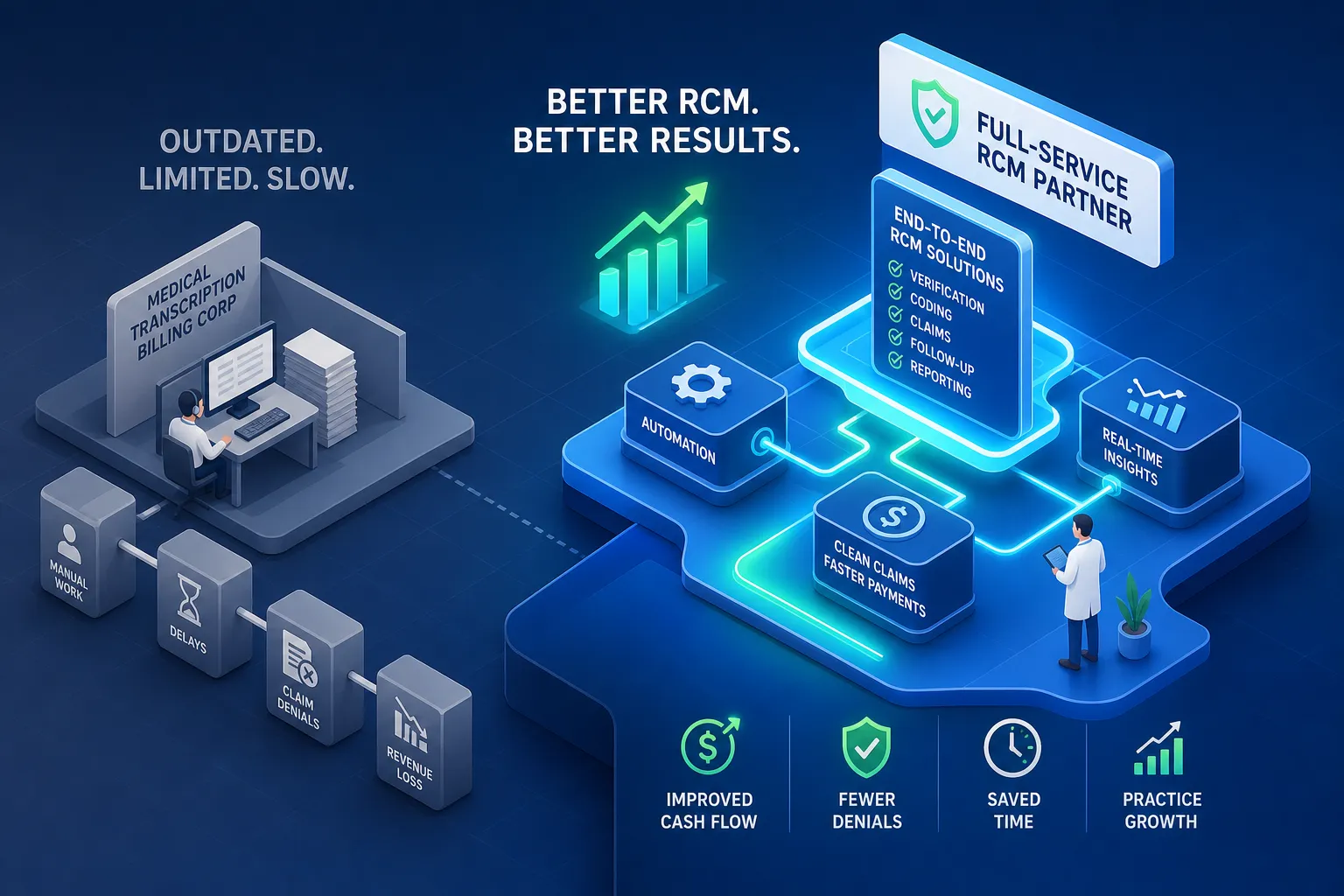
You searched for Medical Transcription Billing Corp. Maybe a colleague mentioned it, or it came up in a comparison post, or you recognized the MTBC name from years ago. Either way, you want to know whether it is the right billing partner for your outpatient practice. That is a reasonable question, and it deserves a straight answer.
MTBC built its identity around medical transcription: converting physician audio into structured clinical notes. Billing came later, layered on top of that documentation workflow. That distinction matters more than most practices realize, because the skills, systems, and institutional thinking required to produce accurate transcription are fundamentally different from working denials daily, chasing prior authorizations, and keeping accounts receivable under 35 days. Confusing the two costs real money.
What follows covers what a transcription-centered billing model actually delivers, where it falls short, which KPIs to watch, and the exact questions to ask before signing anything. CredSpun, a full-service revenue cycle management company for outpatient practices, serves as the reference point for what end-to-end RCM looks like when it is built to cover the complete cycle from the start.
What a transcription-focused billing company covers and where it stops
MTBC started with a clear purpose: get physician dictation into structured clinical notes quickly and accurately. That is a legitimate service. Over time, the company layered billing onto that documentation workflow, and it has since expanded significantly under the CareCloud name to include EHR, practice management, and broader RCM services. But the company's origins matter, because institutional thinking is slow to change.
Transcription-centered billing typically means claims are prepared from completed notes and submitted to payers. Payment posting and basic rejection correction are usually included. What is frequently absent or inconsistent: proactive eligibility verification before the appointment, prior authorization tracking, root-cause denial analysis, and systematic AR follow-up beyond 30 days. Practices often only discover these gaps when they pull their AR report after several months and find balances they did not know existed, a pattern consistent with what industry observers note about limited-scope outsourced medical billing arrangements.
The credentialing and payer enrollment question is worth asking directly. Before any claims can be accepted, providers must be enrolled with each payer, and the clearinghouse must be configured for electronic data interchange. Some vendors offer credentialing as an add-on; others leave it entirely to your front office. Ask specifically whether MTBC or any similar medical billing company will manage payer enrollments, including government and commercial payers, through to a confirmed effective date, not just initiate the applications and move on. HIPAA compliance obligations and payer credentialing rules apply to any vendor handling US patient data, regardless of where that vendor operates.
How Medical Transcription Billing Corp compares on revenue cycle coverage
A complete revenue cycle starts before the patient walks in. Eligibility verification, prior authorization, charge capture, claims submission, payment posting, denial management, and patient balance follow-up are seven distinct stages where revenue can leak, and that is before factoring in coding and charge validation as a separate control point. A partner that manages only the middle stages leaves the practice responsible for the rest. For a lean outpatient clinic, that is too much to absorb internally without losing money.
CredSpun is built to cover all stages of the revenue cycle for outpatient practices, working inside the practice's own practice-management software rather than duplicating it. Credentialing, payer enrollment, clearinghouse and EDI configuration, daily denial management, and patient balance follow-up are all handled by the same team under one engagement, rather than split across separate vendors. For a practice moving away from a transcription-centered vendor, this means no revenue stage is left unmanaged during or after the transition.
Accountability is where the named-contact model makes a tangible difference. Shared billing queues are standard in large RCM companies: you submit a ticket, and someone you have never spoken to responds days later. CredSpun assigns a dedicated named contact to each practice, a person who knows your payers, your denial patterns, and your prior authorization quirks. When something breaks, you call a person, not a queue.
The numbers that separate transcription billing from full RCM
Denial rate, days in accounts receivable, and net collection rate are the figures that reveal whether your billing is actually working. A well-run full-service RCM operation should hold denial rate below 5%, keep days in AR under 35, and maintain a net collection rate above 95%, targets consistent with MGMA benchmarking guidance for high-performing outpatient practices. If your current vendor cannot give you current figures for all three, that silence is itself an answer.
When billing is layered onto a medical transcription service without dedicated denial management or structured AR follow-up, denial rates of 10 to 15% are reported in industry benchmarks, and days in AR can drift above 50, particularly for practices with complex specialty payer rules. Net collection rate is often not tracked at all, because the vendor's contract is structured around submissions, not collections. The practice only notices when cash receipts start falling short of forecasts.
CredSpun's monthly reporting covers clean claim rate, denial rate, days in AR, and net collection rate, broken down by provider, location, and payer. These are not annual summaries; they are monthly, actionable figures that show exactly where a problem sits and what is being done to resolve it. For context, full-service RCM firms managing the complete cycle consistently report denial rates in the 2 to 8% range, compared to 10 to 18% for limited-service or manual billing operations, a gap that compounds into material revenue loss over a full financial year.
Medical Transcription Billing Corp pricing and what to verify before signing
Ask specifically which stages of the revenue cycle are included in the base fee and which are add-ons. Medical Transcription Billing Corp does not publish a comprehensive price list; every practice receives a custom quote. That is not unusual in the outsourced medical billing industry, but it means the contract deserves careful reading. Request a line-by-line explanation of what happens to a denied claim: who works it, by what date, and how the outcome is reported back to you.
Contract and compliance checks
Before any data is shared, confirm the vendor will sign a HIPAA Business Associate Agreement before receiving any protected health information. This is not optional; it is a legal requirement under 45 CFR § 164.504(e), and any vendor who hesitates should be removed from your shortlist immediately. Next, ask for their current denial rate and net collection rate across a comparable client panel. Marketing figures are not the same as operational data. Then review the contract term and exit process closely: month-to-month flexibility is a reasonable expectation, and multi-year agreements carrying high termination fees deserve scrutiny regardless of brand name.
Subcontractor controls
One more question worth asking: does the vendor use subcontractors who process patient data, and are those subcontractors covered by equivalent HIPAA obligations? Large medical coding and billing services providers often route work through offshore teams or third-party clearinghouses. Your BAA should require the vendor to maintain written agreements with every subcontractor that touches protected health information, and you should verify that this chain exists before go-live. MTBC has historically operated processing teams across multiple locations, so this is a specific and relevant question to raise with them directly.
How the switch from transcription billing to full RCM actually works
The biggest concern when switching billing vendors is a gap in revenue. A controlled transition avoids that. The new partner handles all charges from a defined cutover date forward, while open claims from the previous vendor are tracked through to payment. Nothing is abandoned mid-flight. A well-structured first four weeks of onboarding with a full-service RCM partner, representing an industry best-practice transition model, typically looks like this:
- Week 1Practice-management software access granted; open claims inventory audited; active payer contracts and fee schedules reviewed.
- Weeks 1–2Credentialing profiles verified; payer enrollment applications submitted for any gaps; clearinghouse and EDI settings configured so claims transmit correctly from day one.
- Weeks 2–3ERA and EFT enrollment confirmed for all major payers; denial backlog from the previous vendor categorized by root cause; appeals filed on recoverable claims.
- Weeks 3–4First clean claims submitted under the new configuration; denial-management workflow live; dedicated contact confirmed and first check-in call completed with the practice administrator.
Credentialing gaps are identified in week one, so a practice does not discover mid-transition that a provider was never properly enrolled with a key payer. That late discovery is exactly the scenario that creates the cash-flow gap practices fear most. Catching it at the start of the process, before claims go out, is the difference between a smooth transition and a painful one.
The 30, 60, and 90-day reviews after cutover compare results against a documented pre-transition baseline: charges entered, clean-claim rate, denial rate, days in AR, and net collections. Weekly reconciliation of cash receipts against forecast continues until submission, posting, and deposit reconciliation stabilize. When a dedicated contact is accountable for both the transition timeline and the first 90-day performance review, the practice has a single point of responsibility that simply does not exist in a shared-queue model.
Making the decision without overcomplicating it
If you came looking for Medical Transcription Billing Corp, you now have a clear framework for evaluating what it actually provides versus what your practice needs. The distinction between transcription-centered billing and full revenue cycle management is not a marketing argument. It shows up in denial rate, days in AR, and net collection rate. Those numbers are either improving month over month or they are not.
A full-service RCM partner like CredSpun covers every stage of the revenue cycle, handles credentialing and payer enrollment from the start, and gives the practice a named person to call when something goes wrong. If the vendor you are evaluating cannot show you those three KPIs for a comparable client panel, treat that as a strong negative indicator, one that experienced practices use as their final filter in vendor selection.
Practices ready to see how a full-service RCM partner compares to a transcription-and-billing corp arrangement can contact CredSpun directly to request a comparison using their own current figures. The numbers will do the talking.
Compare with your own numbers
See how full-service RCM compares on your denial rate, AR and collections.